
August is a hard month to find time. Winter wheat is off, the corn and beans are made or nearly made, silage is coming, and the shop is full of equipment that needs to be right before harvest. Building maintenance is the thing that gets pushed to November — and then November is wet and cold and it gets pushed to spring.
That is how a two-hundred-dollar fix becomes a twelve-thousand-dollar one. At North Pro we have been doing Ontario barn painting since 1975, and the buildings we end up rebuilding are almost never the ones that got looked at. They are the ones where a screw backed out in 2021 and nobody was up there to see it.
This is the walk-around we would do on your place. It takes about an hour per building and needs nothing but a good pair of binoculars, a flashlight, a screwdriver and a notepad.
Why August Is the Right Month to Inspect Ontario Farm Buildings
By August your buildings have taken a full spring thaw, a season of wind, months of rain and the hottest sun of the year. Everything that is going to move has moved. Three things make this the best inspection window of the year:
- Metal is at full expansion. Steel roofing and siding grow and shrink with temperature. In August, panels sit at their hottest and widest, which puts maximum load on fasteners, washers and lap seams. A gap that is invisible on a cool May morning is wide open at two o’clock on an August afternoon.
- UV damage is at its most visible. Late-summer sun is what breaks down pigment and binder. Walking the building now shows you exactly which elevations are taking the beating — almost always the south and the west.
- You can actually fix what you find. Long daylight, warm surfaces and dry air mean primers and sealants cure properly. Find the same problem in late October and you are fighting dew, short days and surface temperatures too low for a coating to set up.
The counties we work in most — Wellington, Perth, Oxford, Huron, Bruce, Grey, Simcoe and Dufferin — all run the same seasonal pattern. If you are near Stratford, Woodstock or London, our Southwestern Ontario team sees the same August findings on every farm: washers first, then the south wall, then the bottom of the wall.
Step 1: Check the Roof Seams, Fasteners and Flashing…
The roof is where the money is. Almost every serious structural repair we quote started as water coming through a roof penetration that cost nothing to fix. Use binoculars from the ground first — you can see most of this without going up, and nobody should be on a metal barn roof in August heat without proper fall protection.
Lap seams and standing seams
- Sight down the long seams for daylight, buckling or panels that have crept apart.
- Look for dark streaks or dirt trails running downhill from a seam. That is water backing up under the panel in a hard rain — it leaves a mark long before it leaves a stain on your ceiling.
- Check for old sealant that has dried, shrunk back or flaked off. Once the bead is gone, wind-driven rain has a clear path.
Fasteners and rubber washers
A metal roof has thousands of screws, and the small rubber washer under each head is the only thing keeping water out at that point. Washers are the single most common failure we find in August.
- Over-driven screws: the washer has squashed out past the head, split, and is now cooking in the sun. You will see a flattened black ring pushed out sideways.
- Backed-out screws: thermal cycling walks screws out over the years. A raised screw head means an open hole through your roof.
- Dried-out washers: the rubber goes hard, grey and cracked. If you can see cracking around screw heads with binoculars, that roof is taking water on every rain.
Ridge caps, valleys and gable trim
- Ridge cap foam closures get chewed out by birds and weather. Missing closures let snow blow straight into the mow.
- Valleys collect leaves, dust and chaff. Anything organic sitting in a valley holds moisture against the panel and starts rust underneath.
- Check eavestrough hangers and downspout joints for sagging and rust streaking — standing water in a trough is a slow leak waiting to happen.
If the fasteners are widely gone or you are seeing rust across whole panels rather than at isolated spots, that is a metal roof restoration and coating job rather than a patch. A restored and coated roof typically buys 10 to 15 more years at a fraction of what tearing it off and re-sheeting costs.
Step 2: Faded, or Actually Failing? How to Tell the Difference
|
Stage |
What you see |
What it means |
|
1. Fading and chalking |
Even loss of colour; white powder comes off on your hand |
Low risk. Cosmetic. The binder is still doing its job. Clean and overcoat when convenient. |
|
2. Micro-cracking / checking |
Fine grid of cracks across the paint surface |
Medium risk. The resin is breaking down and water is getting into the film. Plan work within a season. |
|
3. Blistering |
Bubbles under the paint film, often on hot elevations |
High risk. Moisture is trapped underneath. When a bubble opens, bare steel or wood is exposed. |
|
4. Flaking and peeling |
Paint lifting off in sheets or chips |
High risk. Adhesion has failed. The substrate is unprotected right now. |
The rub test
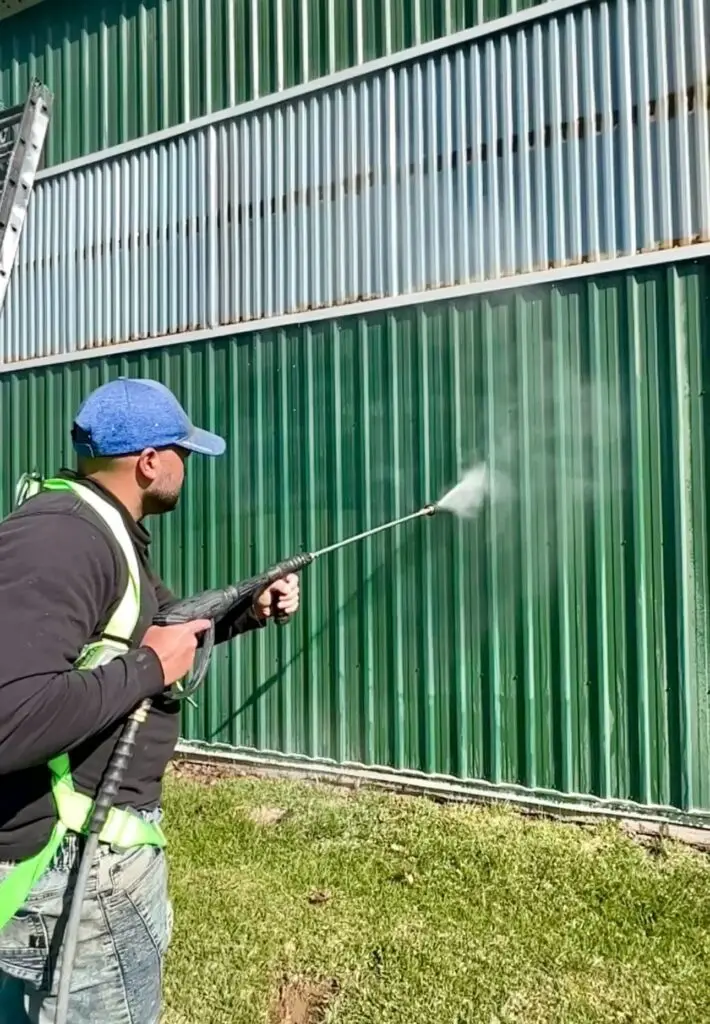
Wipe your hand across a faded panel. If chalky residue comes off but the coating underneath is tight and smooth, that is chalking — normal, and not an emergency. If your hand catches an edge, or a fingernail lifts a flake, the coating has let go and the clock is running.
What each failure is telling you
- Chalking is UV breaking down the binder at the surface. Common on south and west walls. It needs cleaning before any recoat — new paint over chalk will not stick.
- Blistering almost always means moisture behind the film, or a coating applied over a damp or hot surface. Fixing the paint without fixing the moisture just moves the blister.
- Alligatoring — deep grid cracking — means an old coating has gone brittle and can no longer stretch with the building. Water sits in the cracks and works on the steel or timber underneath.
- Peeling in sheets usually traces back to poor prep the last time, or an incompatible coating put over old oil-based paint. This is the one that needs a full strip and system, not a touch-up.
Step 3: Inspect the High-Wear Zones Most People Skip
Some parts of a farm take far more abuse than a plain wall. These are the areas where we find real damage on inspections.
Livestock barns
- Ammonia at the top: ammonia rises and settles on upper purlins, truss plates and interior cladding. Take a flashlight up the ladder and look for pitting and white powdery corrosion on galvanized steel. This is invisible from the floor.
- Splash at the bottom: the lower three or four feet of wall takes manure, washdown chemicals and constant wet. Acidic manure strips ordinary coatings fast, and pitting follows.
We work around biosecurity protocols and milking schedules as a matter of course — that is normal on our dairy and hog jobs across Oxford, Perth and Huron counties, not a special arrangement.
Drivesheds and machinery storage
- Sliding and roll-up door tracks: worn paint in the track grooves turns to rust that binds rollers. Cheap to catch, expensive to ignore.
- Lower wall panels: tire chips, implement dings and stone from the laneway. Look for gouges and flaking down at skirt level.
- Diesel soot on walls and ceiling from equipment parked inside — it holds moisture and degrades ordinary finishes.
Silos, bins and grain handling
- Base rings where steel meets concrete. Water sits in that joint and causes crevice corrosion you cannot see until the ring is thin.
- Discharge chutes, roof hatches and ladder rungs — anywhere friction wears coating away and leaves bare steel.
- Grain legs and elevator structures at every bolt and bracket.
What Waiting Actually Costs
Deferring maintenance feels like saving money right up until the point where it very obviously is not. Here is the escalation we watch buildings climb:
|
Stage |
What the work involves |
Relative cost |
|
Spot touch-up |
Clean, reseal seams, replace fasteners, spot-prime rust points |
$ |
|
Scheduled recoat |
Full wash and prep, prime, complete topcoat system |
$$ |
|
Structural restoration |
Panel replacement, rust remediation, beam and truss repair |
$$$$ |
|
Building replacement |
Teardown and new construction |
$$$$$$ |
For context, a typical full barn painting and restoration project in Southern Ontario runs $8,000 to $35,000 and up depending on size, condition and how much prep is needed. Structural work after years of water entry is a different order of number entirely.
- Coatings are sacrificial by design. Paint and primer are meant to take the weathering so your steel cladding and timber framing do not. Once bare steel is exposed, rust starts thinning the panel immediately, and thinned panels get replaced rather than repainted.
- Maintenance extends a good system. A properly prepped industrial coating gives 10 to 15 years in Ontario weather. Sealing seams, replacing fasteners and treating isolated rust as it appears is what gets you the top end of that range instead of the bottom.
- Water never stays where it gets in. It runs along purlins, down wall framing, into insulation and into post bases. By the time it drips on the floor, the damage above has been going on for a couple of years.
Your August Barn Inspection Checklist
Print this and take it building to building. One page, about an hour each.
Walls and trim
- South and west elevations — chalking, fading, cracking?
- Bottom two feet of wall — splash erosion, trimmer damage, fertilizer burn?
- Around door frames, window trim and corners — bubbling or peeling?
- Brush, trees and crop cut back three feet from the wall for airflow?
Roof and eaves
- Screw washers — cracked, split, squashed out or backed out?
- Lap seams and end laps — gaps, buckling, failed sealant?
- Ridge caps, valleys, gable trim — debris or missing foam closures?
- Eavestrough and downspouts — sagging, leaking joints, rust streaks?
High-wear zones
- Livestock barn upper framing — ammonia pitting, white corrosion?
- Door tracks, rollers and guides — worn paint, active rust?
- Silo base rings and metal-to-concrete joints — trapped moisture?
- Grain legs, chutes and attachment points — friction wear?
Fixing What You Find: What You Can Handle and What Needs a Crew
- Prep decides everything. Never put coating over loose rust, dirt or chalk. Wire-brush the loose material off, scrape flaking back to a solid edge, wash it, and let it dry completely before anything goes on.
- Use a direct-to-metal rust-inhibitive primer. Where steel is exposed or light surface rust has started, a DTM primer built for agricultural metal is the right product. Residential exterior paint will not hold up to the thermal movement on a steel-clad building.
- Replace failed fasteners — do not caulk them. Oversized retrofit screws with larger EPDM washers and a wider thread profile will hold in a stripped hole. Sealant over a bad washer buys you one season at best.
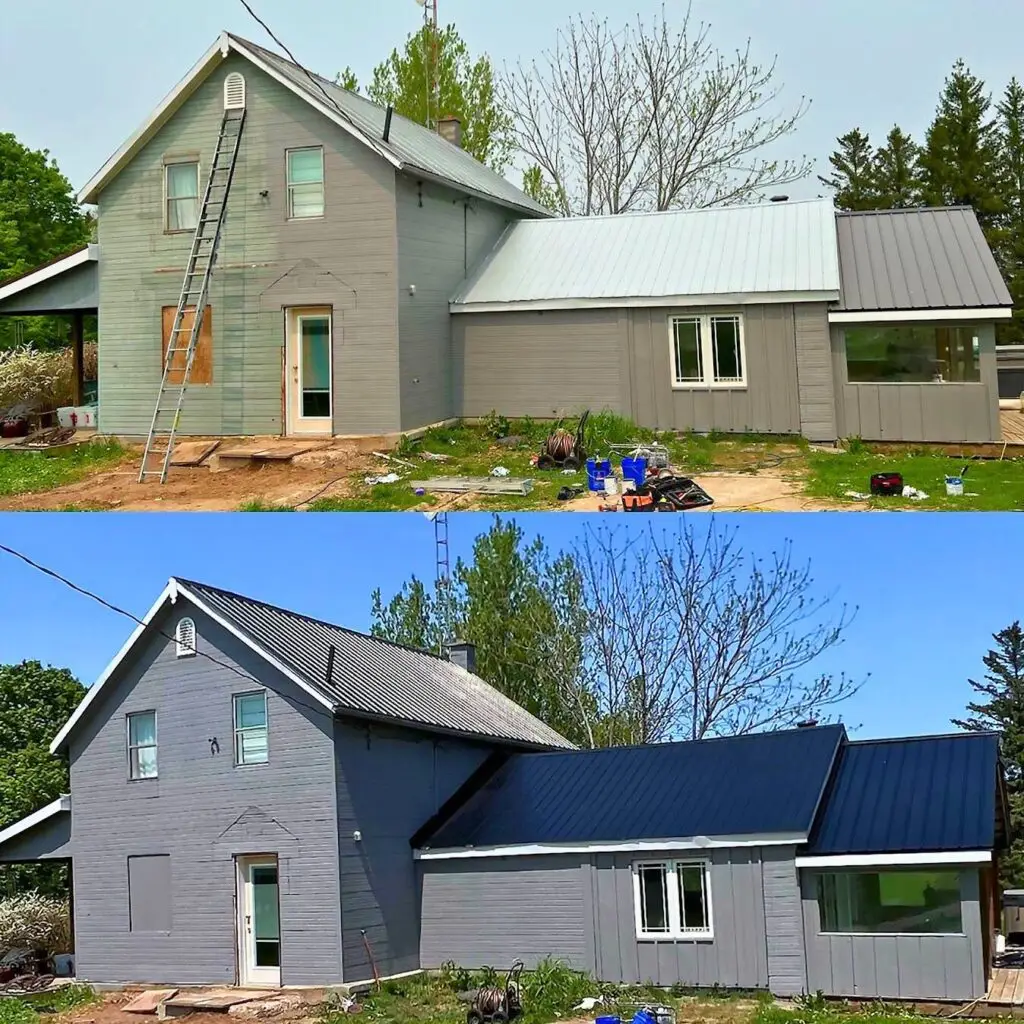
- Know where the line is. Isolated touch-ups are farm-crew work. Widespread peeling, roof-wide rust, high-access work and anything structural needs proper rigging, commercial prep equipment and spray gear — and it needs doing without pulling your people off harvest.
For facility managers and processors reading this, the same logic applies at a larger scale on plants, feed mills and equestrian arenas — see our commercial and industrial facility painting page for how we handle scheduling around production.
Frequently Asked Questions
How often should I inspect my barn roof?
Twice a year is ideal — once in spring after the thaw, and once in August at peak heat. If the building is over 20 years old or has had roof work done, look at it every August without fail. Fasteners and seams are the two things that fail quietly.
What are the signs that a barn needs repainting?
Chalking that comes off on your hand, fine grid cracking in the paint film, blistering, flaking, and any bare metal or bare wood showing through. Chalking alone means you can plan the work. Flaking and exposed substrate mean the building is unprotected now.
How long does barn paint last in Ontario weather?
With proper surface preparation and an industrial-grade polyurethane or elastomeric system, expect 10 to 15 years before a recoat is needed. Cheap residential paint applied over inadequate prep can start failing in two to three years.
Can you paint over a rusty metal barn roof?
Yes, if the rust is surface rust and the panels still have their thickness. The rust has to be mechanically removed or chemically converted first, then primed with a rust-inhibitive DTM primer before the coating system goes on. If rust has perforated panels or eaten through at the fasteners, those sections get replaced, not coated.
Is August too late in the year to paint a barn in Ontario?
No — late August is one of the better windows of the whole season. Surface temperatures and humidity are more stable then than in spring, and coatings have time to fully cure before freeze-up. Our season runs late April through October, and the schedule generally fills well ahead.
Do I need to be there for the inspection?
For our on-site evaluation, it helps but is not required. We walk the buildings, photograph what we find, and give you a written quote that separates what needs doing now from what can wait a season.
Book a Free On-Site Barn Evaluation
If your August walk-around turned up peeling paint, rust across roof panels or seams you cannot reach safely, we will come out and look at it. North Pro has been painting and restoring Ontario barns since 1975 — three generations, family-owned, working the same farms for the same families. You get a written quote, no obligation, and a straight answer about what actually needs doing this year. You can see recent work in our project gallery.
Phone: 519-400-3067
Email: info@northprobarnpainting.com
Office: 2129 Gordon St, Guelph, ON N1L 1G7
Hours: Monday–Friday 6am–8pm · Saturday 8am–1pm
Book online: Request a free on-site quote
Regional teams: Southwestern Ontario · Central Ontario & Simcoe County · Grey-Bruce & Western Ontario · Niagara, Hamilton & Wellington County


